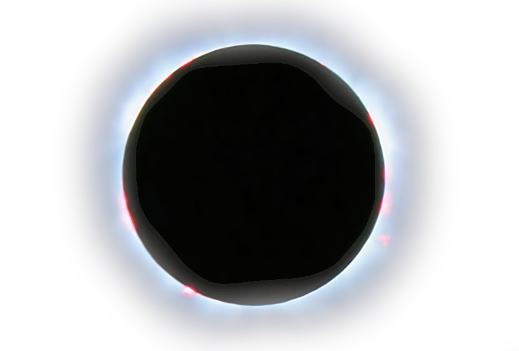
 The Catalogue of The Historical Observations of Solar Eclipses from Europe and Middle East
The Catalogue System
The main part of the catalogue includes solar eclipse data according to a chronological system, beginning with the earliest about which recorded information has been found (the so-called Ugarit eclipse), and ending with the last European total eclipse of the pre-telescopic era, in 1605.
Some other observations made by astronomers from 1605 to 1614 have also been added. The first solar eclipse observed with the aid of telescopes was that of 21 May 1621.
The list gives the following data for each of the eclipses :
- the date of the eclipse according to the Gregorian calendar (the years before our era are marked as negative, not. BC; note the difference by one year, e.g. -135=136 BC and so on),
- the place of observation
Other information is given depending on its availability:
- the name of the observer
- Timed - the original stated time of the eclipse:
hd - hour of the day
CNTCS – the timing of eclipse contacts (the beginning, greatest phase and end, and sometimes partial phases)
SR - at sunrise
ASR - after sunrise
ASS - after sunset
BSS - before sunset
N - about noon
M - in the morning
FN - in the forenoon
AN - in the afternoon
BM - before midday
h AM/PM - hours anti/post meridiem
The next column gives, among others, the sign + which indicates that the source text records the information on a given subject in an unquestionable way.
If there is some doubt but the context shows that the item is very probable, the letter “C” is put - concluded.
Other signs are listed below :
T - total eclipse (C-concluded from the text)
A - annular eclipse
Dis - disappearance of the Sun
P - partial eclipse - if there is more detailed data concerning the magnitude of the phase, they are designated by the following symbols :
CR - the Sun was like the crescent Moon
CR number - means the Moon’s age in days when this phase of the Moon resembled the phase of the crescent of the deeply eclipsed Sun, e.g. CR2 – the solar crescent resembled the 2 day old Moon.
fraction A - the eclipsed part of the solar disk area
fraction D - the eclipsed part of the solar disk diameter
number d - the phase in digits (12 digits = diameter of the Sun = total eclipse)
NT - nearly total eclipse
GP - greatest part of the Sun eclipsed
LP – least part of the Sun eclipsed
B - beginning noticed,
M - maximum phase estimated
E - end noticed
PH - phases of the eclipse described; these descriptions were sometimes very scant;
G – „a great eclipse occurred”;
GD - great darkness; the term also covers such expressions as a sudden darkening of the sky and turning the day into night ;
TW - twilight effect: a distinct darkening of the sky and the ground reminding one of twilight or a cloudy day;
SV - stars visible; this term has been overused and occurred as a “necessary term” when describing a solar eclipse;
V - Venus observed; Venus was often observed even during partial eclipses and this gives a basis for estimation of the eclipse phase;
WD - weather described; any information of meteorological character
For the Western-European and Polish observations a separate notation was used.
In the current version of the catalogue, the maps of centrality have been included on the map of Europe. The maps with paths of centrality are taken from the web portal https://www.solar-eclipse.info/ by A.Möller. The data have also been checked with the help of the Occult v.4.6.5 program.